Sections/Lessons
Section 1. Lesson 1. Metric System
For example: Convert 43 km (kilometers) to m (meters).
Step 1. Find the place of kilos and the basic unit within the system. Notice how it is 3 places to the right of the basic unit.
Step 2. Move the decimal point 3 times to the right, or multiply by 1000. 43 x 1000 = 43000
Answer. 43 km to meters is 43000 m.
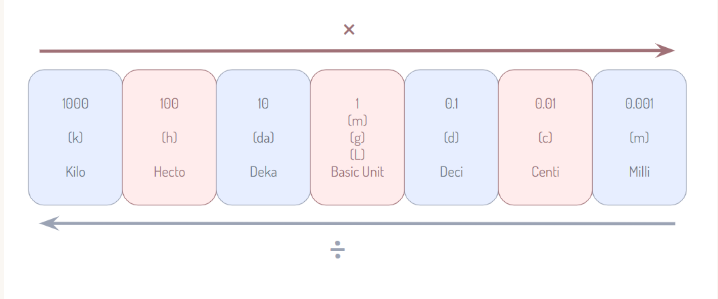
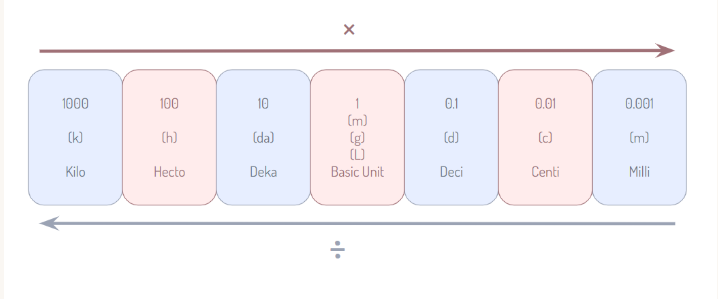
People worldwide, such as scientists, use the metric system. This is a crucial system to use as it provides precise measurements, which are easily applicable to other things. The metric system consists of Kilo (k), Hecto (h), Deka (da), Basic Units, Deci (d), Centi (c), and Milli (m).
When converting to a larger unit, you may move the decimal point to the left as many units as you are moving to; you can also divide.
When converting to a smaller unit, you have to move the decimal point to the right as many units as you are moving to; you can also multiply.
Section 1. Lesson 2. Significant Figures
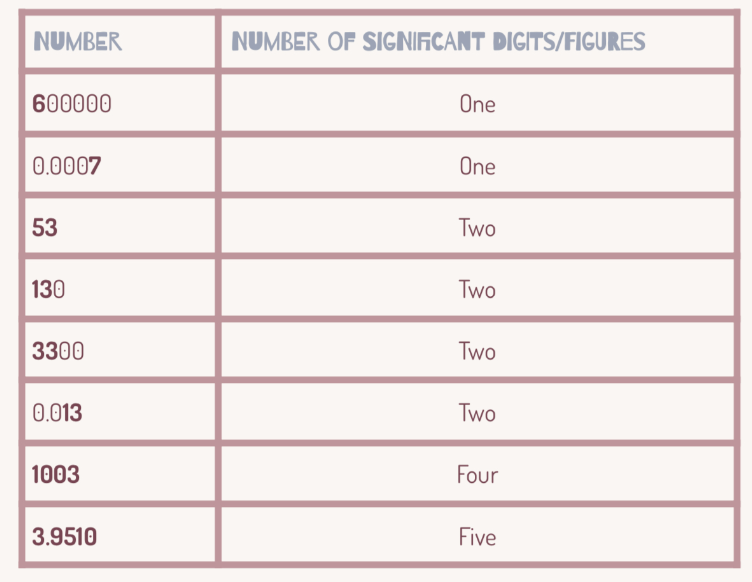
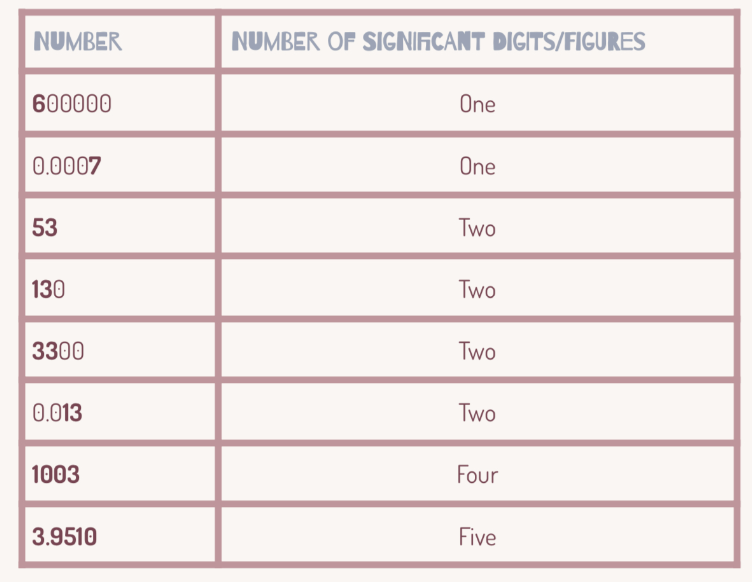
Significant figures are the number of digits in any valid measurement. The numbers are a direct result of the number of divisions that a measuring device can contain.
Multiplying and Dividing: When two measurements are multiplied (or divided), the answer should have the least amount of Sig Figs, aka as many digits as the less precise measurement.
Adding and Subtracting: When two measurements are added (or subtracted) the answer should have the least amount of decimal places aka as many decimal places as the number with the least amount of digits after the decimal.
Rounding: If we round a number to a certain number of Sig Figs, the last number you're rounding to will stay the same if the number right next to it is between 0-4, and will increase by one if the number next to it is 5-9. Since zeros at the end of a whole number without a decimal point don't count as Sig Figs, and (in this case) we're rounding to 1 sig fig, the zeros act as place holders for the numbers that do not count as Sig Figs anymore.
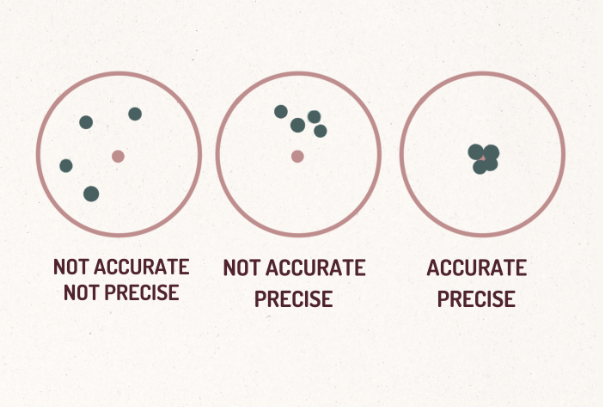
Everything in science has to do with measurements. We must understand that all measurements will never be perfect, so we use a degree of uncertainty. There are two parts regarding this:
Accuracy: is concerned with how suitably a measurement complements its accepted value.
Ex: The current time in your location is 6:55 PM, but your old watch shows 6:58 PM. There is a consistent 3-minute difference between the accepted value and your watch, indicating the accuracy of the measurement on your watch.
Precision: is concerned with how suitably a measuring device can generate a measurement. However, this is limited to the construction and design of the device (How many numbers and how many lines are in between those numbers). We can never acquire a result that is more precise than the limit of the device.
Ex: A meter stick's smallest division is 0-1 m, so the limit is to the hundredths place of the value. We can say that the precise measurement of the given pencil could be anything between 0.2-0.3: 0.25, 0.24, 0.23, anything in that range.
Section 1. Lesson 3. Scientific Notation
Scientific Notation is a simpler form of writing numbers that are too large or too small. For example, if you have a huge number with many zeros in it, then writing it in Scientific Notation is way easier. If you wrote it normally, there is a chance that you could have forgotten a zero or written an extra zero, which would make your answer wrong.
The Formula/Base of Scientific Notation: M x 10^n.
Mantissa: Mantissa, also known as the symbol M, is a real number that's either greater than or equal to 1 and less than 10. You can remember it by using greater than or less than symbols! 1 ≤ M < 10
N: Here, the symbol N means the exponent.
When writing/converting a symbol into Scientific Notation, you move the decimal until the mantissa is a number between 1 and 10.
IMPORTANT: When given a number below one, the exponent will be negative.
Ex: Write the number 0.0000000000034 from Standard Notation into Scientific Notation.
This number is less than one, so it will have a negative exponent.
Move the decimal point as many times as you need, until the decimal point is at the first non-zero digit.
With our example, you need to move the decimal point 12 times until the decimal is with a non-zero number. In this case, the first non-zero number is three.
Therefore mantissa will be 3.4.
We know the exponent (n) will be -12, since the number is less than one, so it will be negative, and we moved 12 times until the decimal point was right in front of the three.
Answer, 3.4 x 10^-12.
Ex: Write the number 30107300 from Standard Notation into Scientific Notation.
IMPORTANT: All numbers larger than 1 will have a positive exponent.
This number is larger than 1, so it will have a positive exponent.
Although the problem doesn't show it, we know that the decimal in this number will be last. 30107300.
First, count from the decimal point and move it until it's right in front of the first number, which is 3.
In this case, the decimal point can move 7 times.
Therefore mantissa will be 3.0107300.
We know that the exponent (n) will be 7, since the number is larger than 1 so it will be positive, and we moved 7 times until the decimal was right in front of the first number, 3.
Answer: 3.0107300 x 10^7.
Standard Notation:
When writing numbers that are already in Scientific Notation and you need to write/convert it into standard notation, you will know to move to the right or two to the left based on the exponent. If the exponent is Negative, you will move to the left. If the exponent is Positive, you will move to the right.
Ex: Write the number 7.31. x 10^-3 from Scientific Notation into Standard Notation.
Here, we see that we have a -3 as our exponent, so we will move to the left. This tells us that our number will be less than 1.
First, you take 7.31 and take the decimal and move it 3 times to the left. Then you will see the missing places in between and place the zeros. In this case, there are spaces for 2 zeros in between the new place of the decimal.
Answer, 0.00731.
Ex: Write the number 1.579 x 10^5 from Scientific Notation into Standard Notation.
Here, we see that we have a 5 as our exponent, so we will move to the right. This tells us that our number will be larger than 1.
First, you take 1.579 and take the decimal and move it 5 times to the right. Then you will see the missing places in between and place the zeros. In this case, there are spaces for 2 zeros in between the new place of the decimal.
There is no need to put a decimal in the final answer, as there are no decimals following.
Answer, 157900.
Section 1. Lesson 4. Percent error
Ex: Jessica measures the density of an object to be 5.6 g/cm^3. The accepted density of the object is 6.4 g/cm^3. What is the percent error of their measurement?
First you plug the numbers into the formula. 5.6 is the measured value. 6.4 is the accepted value.
To start off you will subtrade the measured value - the accepted value, which would be 5.6 - 6.4.
Then you get your answer which is -0.8. From here you divide your answer by the accepted value. -0.8/6.4.
Then you get the answer of -0.125. You will next multiply your answer by 100. -0.125 x 100.
Your answer will be -12.5. Therefore, the percent error is -12.5 and the magnitude is 12.5. Unless, specifically asked, you can just switch the negative sign into a positive as we are generally concerned with the magnitude.
Percent Error is to show how close a estimated measurement is to an actual/accepted value. It compares two measurements together, and shows the precision/accuracy of the estimated and actual value.
Percent Error is quite simple, you just have to plug it into the correct formula. When using the percent error formula, we are more focused on the magnitude of the error instead of the algebraic sign in front of it.
The Formula for Percent Error: The formula is given in the photo, but to explain it, to get Percent Error, you take the Measured Value and Subtract it from the Accepted value. From there you divide your answer by the accepted value and then multiply it by 100.


Section 2. Lesson 1. Matter.
Matter is anything that holds mass ( atoms in an object ) and a volume ( the amount of space which something holds/occupies/takes up.
Matter is made up of atoms, and these are extremely tiny particles that make up everything around us, and they can not be broken down chemically.
If confused some examples of Matter can be, these include but are not limited to:
atoms
water
any object
Elements, a foundation used for almost everything. These are pure substances due to being identical, as mentioned before, the tiniest part of an element is the atom in it.
Diatomic Elements: These elements are not themselves, but have chemical bonds with each other; they exist in pairs. To be specific, the Diatomic Elements are: Hydrogen, Oxygen, Nitrogen, Chlorine, Bromine, Iodine, and Flourine.
If looking to memorize these, use this: HONClBrIF. Pronounced: (HONK-UL-BRIF)
A compound is very simple, they are atoms of different elemets which combine to create a compound, these have chemical formulas and can only be seperated by a chemical reaction.
If confused some examples of Compounds are, but not limited to:
Water: H2O
Carbon Dioxide CO2
Ammonia: NH3
To know the difference between the elements and compounds then you can just look if the symbol is an uppercase or lowercase letter. For example if there are more then two uppercase letters, then it has to be a compound, for example GaAs, Gallium Arsenide is a compound. A regular element can be B for Boron or Ac for Actinium.
Law of Definite Proportions: Types of atoms that are in a ompound will always exist in a fixed ratio, no matter the amount the compound will always be composed of the same elements in the same promortion by mass, basically always the same rartio in a compound.
Section 2. Lesson 2. CLASSIFYING MATTER & SEPERATION
Seperation Techniques:
Chromatography: This method seperate solubles that are mixed together. It is often used to separate the mixture back into its color. We do this through solubility, polarity, and color.
Distillation: Separating two different mixtures through their boiling points.
Evaporation: This separates a solution by deriving the solid component from a liquid component.
Filtration: Through a funnel the pure substance passes through a filter, while the solid particles are trapped by the filter paper because of particle size. This seperates the pure substance and solid.
Separating Funnel: This separates two liquids that cannot mix, due to solubility and polarity.
Electrolysis: Electricity separates two compounds.
Heterogeneous vs. Homogenous:
To understand the terms above, we must understand the difference between a pure substance and a mixture. Elements and compounds are generally categorized as pure substances because they can't be physically separated, and are made up of the same things. Random blends that contain various pure substances are classified as mixtures because they can be physically broken down.
Mixtures are where homogenous and heterogenous substances come into play. Homogenous mixtures are evenly mixed like milk, coffee, and lemonade. Heterogeneous mixtures are the opposite in which you can physically see different parts of the substance. Examples like pizza, trail mix, and jelly beans are all heterogeneous because they show an uneven mix of an amount.
Section 2. Lesson 3. physical/Chemical properties
Physical Properties:
Physical properties are types of properties that cannot chemically alter a substance.
Example: Melting point, Luster, Conductivity, and color.
Chemical Properties:
Chemical properties are changes that undergo which alters a substance's overall being.
make picture below
Examples in real life:
Baking brownies: A chemical change because the batter transforms into a new substance ( the brownie.) Isn't a nice gooey brownie the best?!!
Shredding paper: A physical change because it doesn't chemically alter the substance. Its still paper just in smaller pieces!
The Statue of Liberty oxidizing: A chemical change because the copper interacted with oxygen causing the monument to be green.
Section 2. Lesson 4. physical changes
Solid: A solid is a type of matter that has particles that are always bundled together. A solid has a definite shape and volume regardless.
Liquid: A liquid has particles that are closely bundled together but have the ability to move around; they have an indefinite shape and definite volume.
Gas: A gas has particles that are separated and can move freely, an indefinite shape, and an indefinite volume.
PHASE CHANGES: Physical changes that convert matter from one phase to another.
To memorize, you can sort these into three "houses"! Each house has 2 phase changes, which are like the opposite of each other!
EVAPORATION: liquid turns into a gas MELTING: solid turns into a liquid SUBLIMATION: solid turns into a gas
CONDENSATION: gas turns into a liquid FREEZING: liquid turns into a solid DEPOSITION: gas turns into a solid
Endothermic Reaction: This type of reaction absorbs heat from its surroundings.
Exothermic Reaction: This type of reaction releases heat into its surroundings.
Each phase change is categorized into these. If the first letter is green, it is an endothermic reaction. If the first letter is black, it is an exothermic reaction.
Heating Curve: Kinetic Energy: Energy caused because of the movement of particles.
Cooling Curve: Potential Energy: Energy inside a substance, its potential to move around.
Section 2. Lesson 6. Heat of fusion/heat of vaporization
Heat of Fusion:
Heat of Fusion means the amount of heat energy necessary to melt Photo
a solid into a liquid. To calculate the heat of fusion, you will need to
plug in to its equation!
LETS PRACTICE: SOLVE THIS EQUATION.
How many joules are required to melt 50 grams of water at 0°C?
The heat of fusion for water is: 334 J/g.
Use the equation Q = m x Hf
Plug in your numbers provided in the problem,
Q= 50g x 334 J/g
Multiply, and 16700 J is your answer.
Heat of Vaporization:
Heat of Fusion means the amount of heat energy necessary to boil Photo
a liquid into a gas. This means evaporation. To calculate the heat of
vaporization, you will need to plug in to its equation!
LETS PRACTICE: SOLVE THIS EQUATION.
How many joules are required to evaporate 230 grams of water at 100°C?
The heat of vaporization for water is: 2260 J/g.
Use the equation Q = m x Hv
Plug in your numbers provided in the problem,
Q= 230g x 2260 J/g
Multiply, and 519800 is your answer.
Heat of Fusion and Heat of Vaporization is just as simple as that! All you have to do is keep your formulas in mind, and you will come to the solution extremely quickly.
Section 2. Lesson 7. Temperature/Heat
Temperature is the average KINETIC ENERGY of all the particles in a substance. This means that the higher the temperature is, the greater the average KE is.
Heat is the flow of THERMAL ENERGY (total energy produced by the motion of particles) between two things as a result of the temperature difference.
Heat can flow from the source of the heat to its surroundings, and vice versa.
UNIT CONVERSIONS:
For temperature, the main units used in science are K, Kelvin, and °C, or degree Celsius.
To convert from Celsius to Kelvin, simply add 273 to the number of degrees. And subtract 273 when doing the opposite.
For Heat, it is generally represented by the Q and can be written as negative for positive.:
If the reaction is exothermic, heat is released from the source to its surroundings (i.e, a cup of hot coffee), and will result in -Q
If the reaction is endothermic, heat is absorbed from the surroundings to the source (i.e, a cup of iced coffee) and will result in +Q
ABSOLUTE ZERO:
This happens when the temperature is measured at 0 K or -273 °C. It's almost impossible to reach this state because all molecular motion stops. Not even a generic solid can do that!
Section 2. Lesson 8. Calorimetry
Calorimetry is the measurement of constants related to heat, like specific heat.
Scientists often use a Calorimeter, which is a device used to measure heat:
whether it is absorbed or released in either a physical or chemical change. photo
Specific Heat
Section 3. Lesson 1. Heat of fusion/heat of vaporization